
The Ultimate Poker Guide from A to Z: How to Master the Game as a Beginner
Poker is far more than just a game of luck; it is a captivating blend of strategy, psychology, and probability. Whether you want to play for fun with friends or dominate the online tables, understanding the core fundamentals is your first step.
This comprehensive guide will walk you through everything you need to know about how to play Poker and maintain a winning edge.
1. What is Poker? Why is It So Popular?
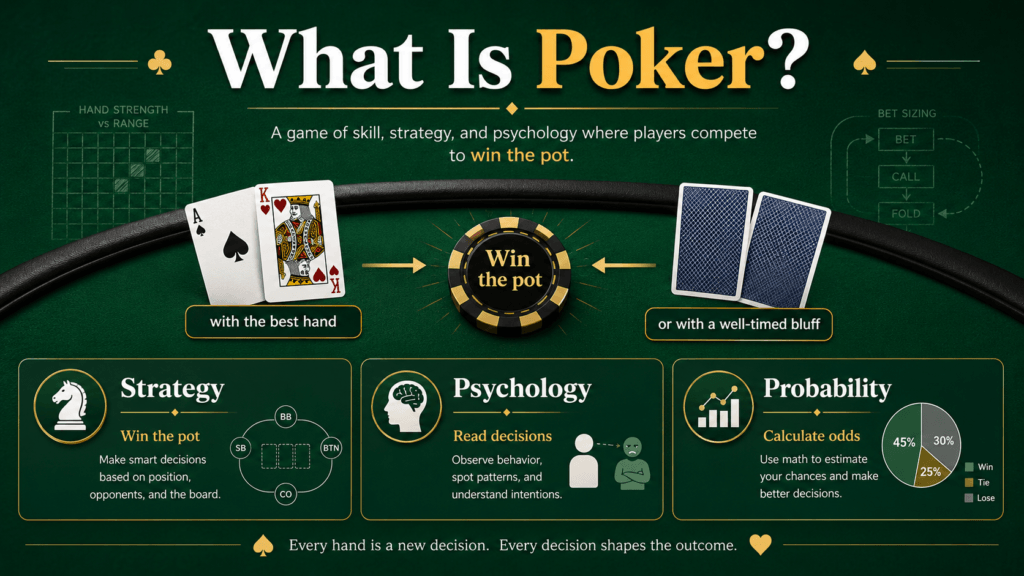
Poker is a family of strategic card games played with a standard 52-card deck. The primary goal is to win the “pot” (the accumulation of bets made during the hand) either by holding the highest-ranking card combination at the end of the game or by successfully bluffing your opponents into folding.
Unlike purely luck-based casino games, Poker is widely recognized as a mind sport. Its global appeal stems from:
- High Strategic Depth: Players must constantly calculate pot odds, implied odds, and mathematical probabilities.
- Psychological Warfare: Mastering the “Poker Face”—reading opponents’ physical or betting tells while concealing your own emotions.
- Skill Over Luck: In the short term, anyone can win a hand. In the long term, skilled players consistently make money.
2. Basic Rules of Texas Hold’em Poker
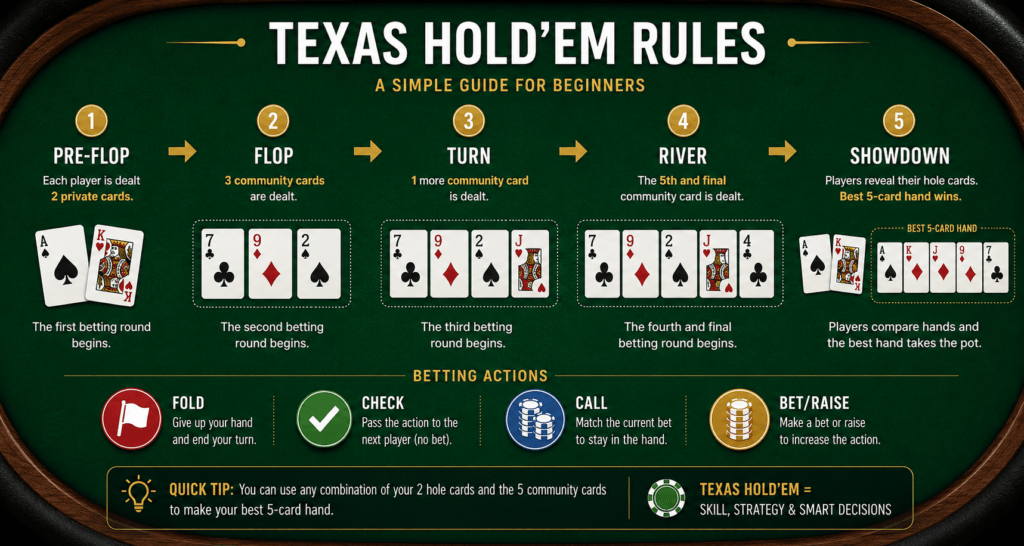
While there are many variations, Texas Hold’em is undisputedly the most popular Poker variant worldwide. Here is the step-by-step breakdown of a standard hand.
Player Actions in Each Betting Round
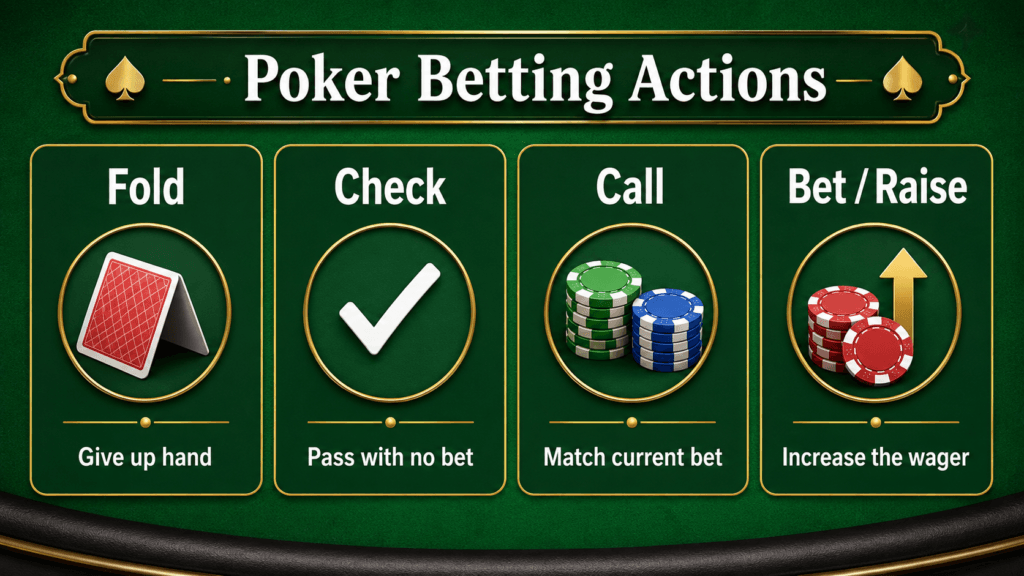
When it is your turn to act, you have the following options:
- Fold: Give up your cards and forfeit any money already put into the pot to avoid losing more.
- Check: Pass the action to the next player without betting (only possible if no one before you has made a bet).
- Call: Match the amount of the current highest bet to stay in the hand.
- Bet/Raise: Place a new wager (Bet) or increase the size of an existing bet made by a previous player (Raise).
The 4 Main Betting Rounds
- Pre-Flop: Every player is dealt 2 private cards face down (known as “hole cards”). The first round of betting begins.
- The Flop: The dealer lays 3 community cards face up in the center of the table. Players combine their hole cards with these community cards, followed by the second betting round.
- The Turn: A 4th community card is dealt face up. The third betting round takes place.
- The River: The 5th and final community card is dealt face up. This triggers the final, high-stakes betting round.
- The Showdown: Remaining players reveal their hole cards. The player with the best 5-card combination wins the pot.
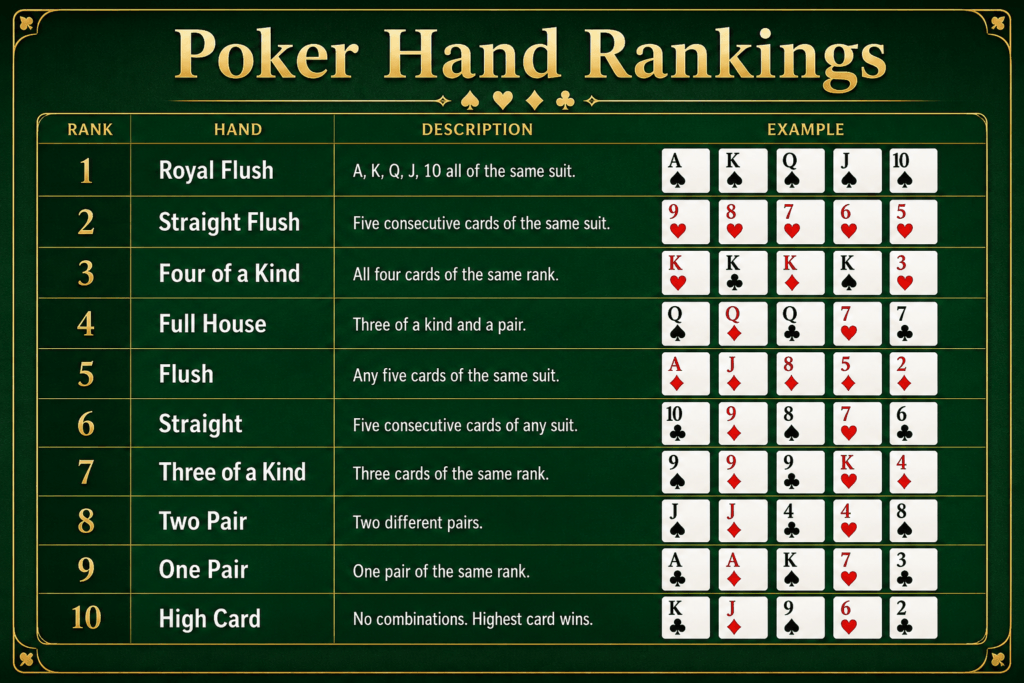
3. Official Poker Hand Rankings (Highest to Lowest)
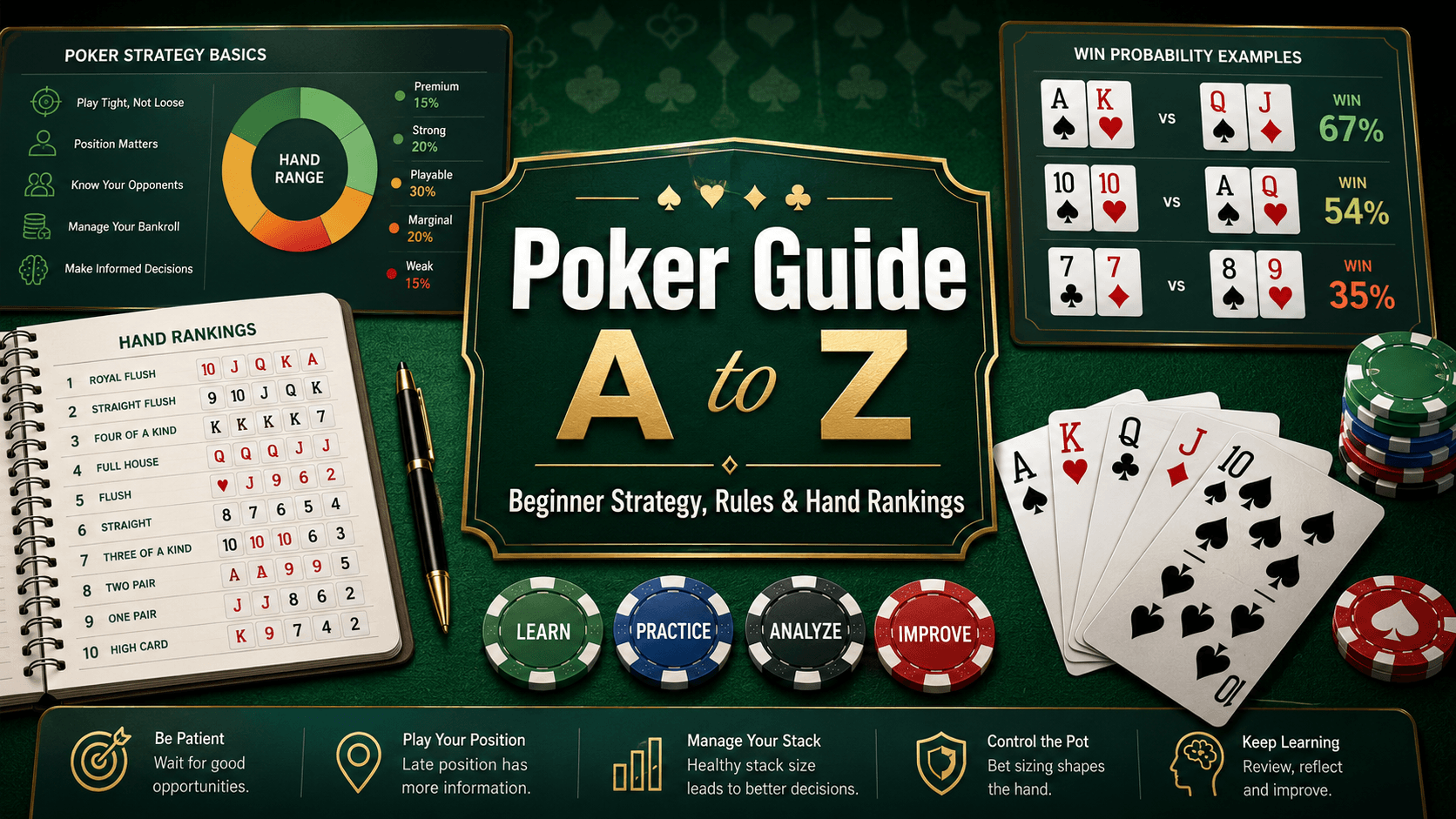
To make informed decisions, you must memorize the traditional hand rankings by heart:
| Rank | Hand Name | Description | Example |
| 1 | Royal Flush | A, K, Q, J, 10 of the exact same suit. | 10♠, J♠, Q♠, K♠, A♠ |
| 2 | Straight Flush | 5 consecutive cards of the same suit. | 5♥, 6♥, 7♥, 8♥, 9♥ |
| 3 | Four of a Kind | 4 cards of the same numerical rank. | A♣, A♦, A♥, A♠ |
| 4 | Full House | 3 of a kind combined with a pair. | K♣, K♦, K♠, 9♥, 9♦ |
| 5 | Flush | Any 5 cards of the same suit, not in numerical order. | 2♦, 5♦, 7♦, J♦, K♦ |
| 6 | Straight | 5 consecutive cards of mixed suits. | 4♠, 5♥, 6♦, 7♣, 8♠ |
| 7 | Three of a Kind | 3 cards of the same numerical rank. | 7♣, 7♦, 7♥ |
| 8 | Two Pair | 2 different pairs of cards. | Q♣, Q♦, 8♥, 8♠ |
| 9 | One Pair | 2 cards of the same numerical rank. | J♠, J♦ |
| 10 | High Card | No combinations; evaluated by the highest single card. | A♣ |
4. Top 3 Poker Strategies to Master the Table
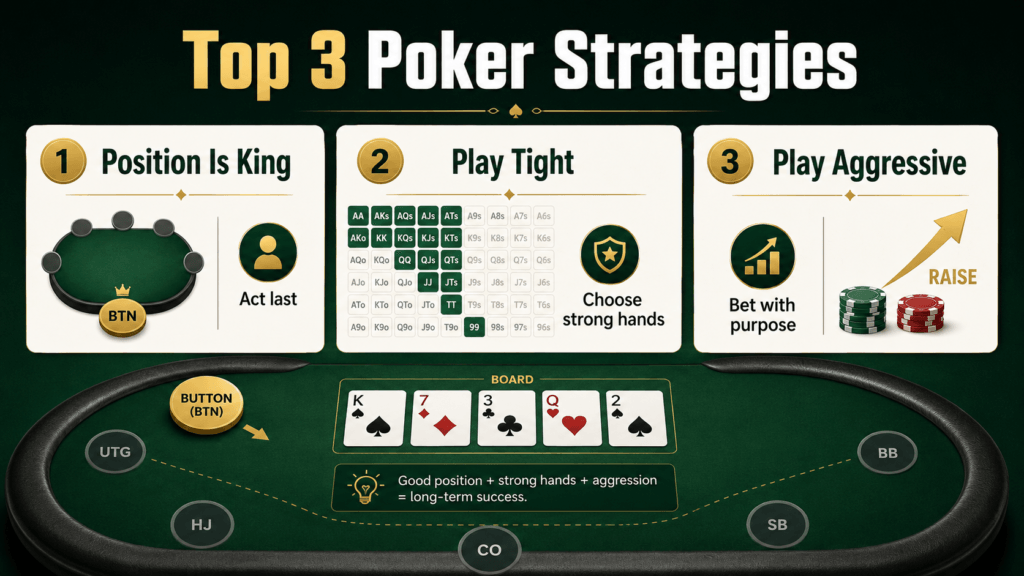
Relying solely on “good cards” won’t take you very far. To win consistently, integrate these 3 core strategic elements:
Position is King: Acting last in a betting round (such as sitting on the “Button”) is the ultimate advantage. It allows you to watch how every other player reacts before you have to make your move.
- Play Tight (Selectivity): Don’t play every hand. If your starting hole cards are weak (e.g., an unsuited 2 and 7), fold immediately in the Pre-Flop stage. Patience is a virtue that saves your bankroll.
- Play Aggressive: When you do decide to enter a pot with strong cards, lean toward betting and raising rather than just calling. Aggression forces opponents to make tough decisions, lets you dictate the pot size, and can win you the pot immediately if they fold.
- Proper Bankroll Management: Never risk money you cannot afford to lose. Divide your poker funds into smaller units and buy into games that match your budget so that variance and short-term bad luck don’t wipe you out.
5. Conclusion
They say Poker takes “a minute to learn, but a lifetime to master.” Becoming a winning player requires a balance of solid foundational knowledge, sharp emotional discipline, and continuous practice.
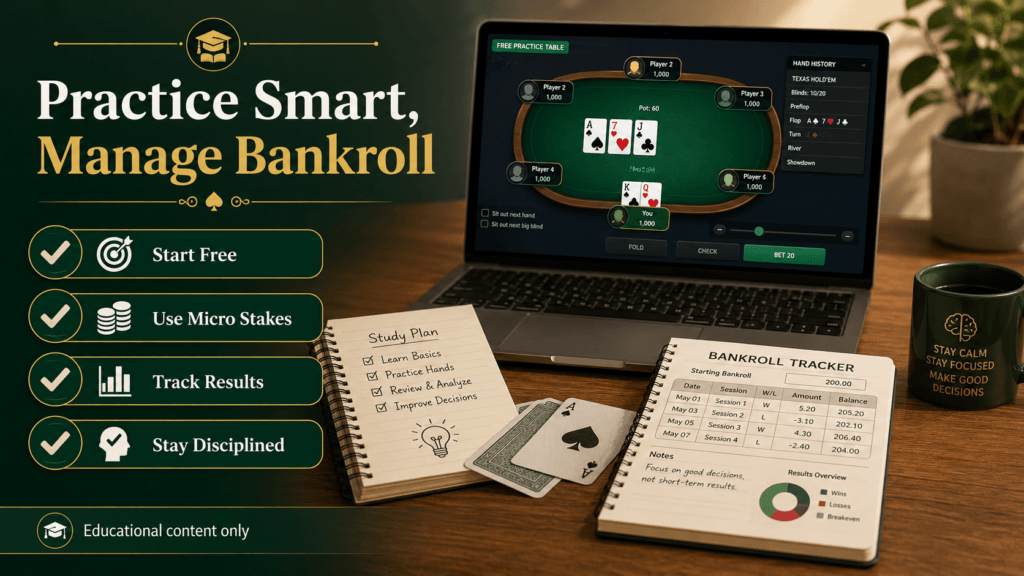
Ready to test your skills? Start practicing on free poker apps or micro-stakes tables today to build your confidence and experience risk-free!